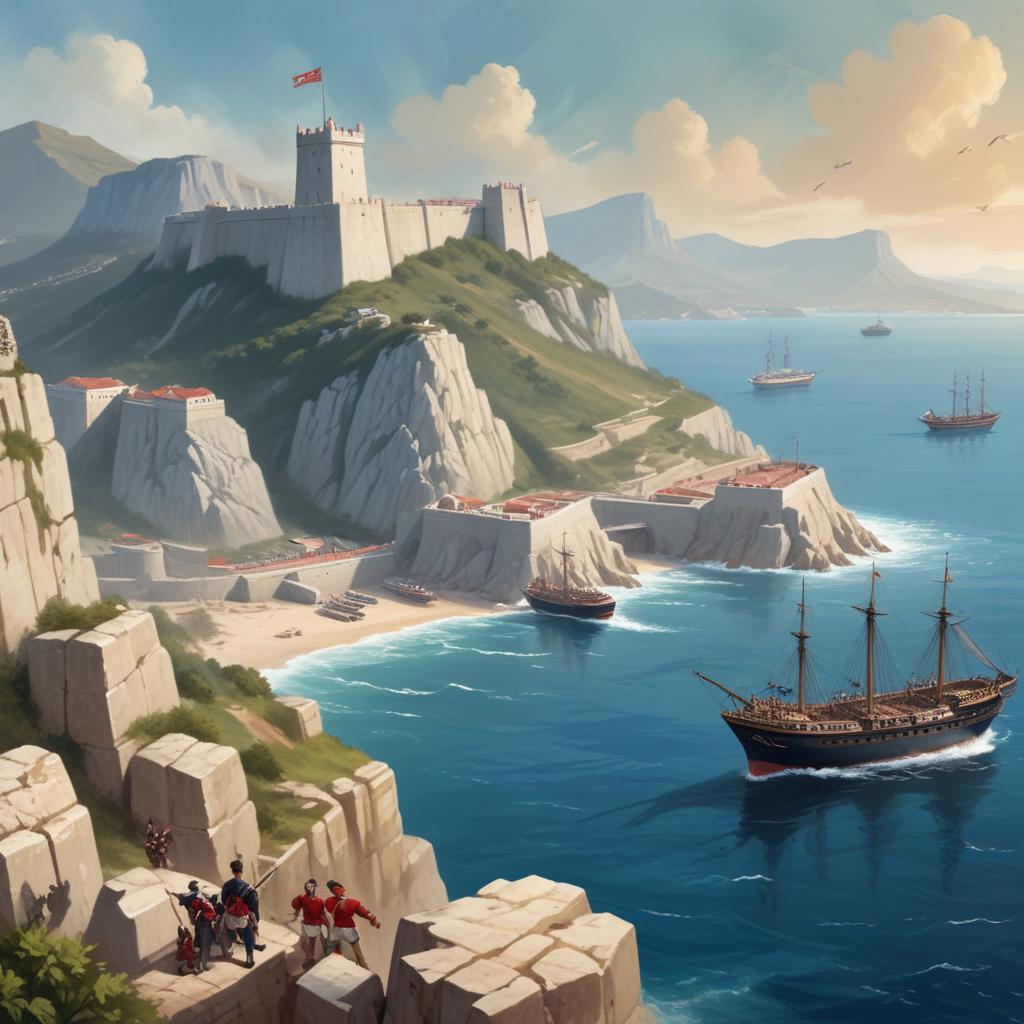
Strategic Importance of Gibraltar during the Napoleonic Wars
Gibraltar played a critical role in the Napoleonic Wars due to its unparalleled strategic importance as a fortress and naval base. Its unique geographic position at the entrance of the Mediterranean Sea made Gibraltar indispensable for military strategy during this tumultuous period of European conflict. The rock itself commands the narrow Strait of Gibraltar, the vital maritime passage connecting the Atlantic Ocean to the Mediterranean. Control of this gateway allowed the British and their allies to monitor and restrict French naval movements, thereby influencing the balance of power in the region.
Throughout the Napoleonic Wars, Gibraltar served as a key stronghold for the British Royal Navy, providing a secure base from which to launch operations into the Mediterranean basin. Its location enabled the British fleet to effectively blockade French and allied ports, disrupting supply lines and limiting the enemy’s ability to project naval power. The fortress’s robust defenses also ensured that it remained impregnable, denying Napoleon’s forces a crucial foothold that could have threatened British dominance at sea.
Moreover, Gibraltar’s control over naval routes was essential for safeguarding British commerce and maintaining lines of communication with colonial territories. The strait’s narrowness meant that any fleet passing between the Atlantic and the Mediterranean had to navigate close to Gibraltar, allowing the British to exert significant influence over Mediterranean naval operations. This control not only served military purposes but also protected vital trade routes, underpinning British economic strength during the prolonged conflict.
In summary, Gibraltar’s strategic importance during the Napoleonic Wars was a product of its geographic position and its command over the vital maritime routes into and out of the Mediterranean. Its role as a military bastion and naval chokepoint made it a linchpin in the broader military strategy of the British and their allies, ultimately contributing to the containment and defeat of Napoleonic ambitions in the region.
Geopolitical Context
The Napoleonic Wars occurred during a period of intense geopolitical upheaval in Europe. The continent was divided between competing empires and shifting alliances, with France under Napoleon Bonaparte seeking dominance across Napoleonic Europe. Control of strategic locations was essential for maintaining power, particularly in areas that influenced trade and military movements in the Mediterranean. Gibraltar, held by the British Empire, was one such pivotal stronghold. Situated at the entrance to the Mediterranean Sea, Gibraltar allowed the British to monitor and control naval passage between the Atlantic Ocean and the Mediterranean basin.
This strategic position gave the British Empire a crucial advantage in asserting its influence over Mediterranean control. By holding Gibraltar, Britain could limit French and allied naval operations, disrupt supply lines, and protect its own maritime interests. This control also enabled Britain to support operations in southern Europe and maintain communication with its colonies and allies. The presence of a fortified British base challenged Napoleonic ambitions and helped preserve the balance of power in the region. Thus, Gibraltar’s role was not merely military but deeply integrated into the larger geopolitical dynamics of the era.
In summary, Gibraltar’s control was a key factor in the geopolitics of the Napoleonic Wars. It underscored the importance of naval supremacy and territorial possession in shaping the outcomes of conflicts. The British Empire’s hold over Gibraltar enhanced its strategic reach and contributed to the containment of Napoleonic expansion in Europe, emphasizing the critical link between geography and power in this transformative period.
Naval Significance and Blockades
During the Napoleonic Wars, Gibraltar held immense strategic value as a naval base, crucial to British naval warfare efforts in the Mediterranean. Its geographical position at the entrance of the Mediterranean Sea allowed the British Navy to effectively monitor and control Mediterranean naval routes, which were vital for trade and military movements. Gibraltar became the linchpin for British blockades, aimed at restricting French and allied naval operations and supplies.
The British Navy used Gibraltar as a launch point for blockades against French and Spanish ports, severely limiting the enemy’s ability to reinforce and resupply their forces by sea. These blockades were instrumental in maintaining British naval superiority and disrupting the coordinated efforts of Napoleon’s forces. Gibraltar’s natural harbor and fortifications provided a secure and well-defended base from which the Royal Navy could launch patrols and intercept hostile ships attempting to traverse the Mediterranean.
Additionally, Gibraltar’s naval facilities supported the maintenance and repair of British warships, ensuring that the fleet remained operational throughout the prolonged conflict. The presence of a strong British naval force at Gibraltar not only safeguarded British maritime interests but also helped to isolate French and allied forces, forcing them into a defensive posture. Overall, Gibraltar’s strategic role in naval warfare and blockades was a decisive factor that contributed significantly to the British dominance in the Mediterranean during the Napoleonic Wars.
Military Actions and Defense of Gibraltar
| Aspect | Details |
|---|---|
| Military Defense | The British garrison in Gibraltar during the Napoleonic Wars maintained a state of high readiness, continually strengthening fortifications and upgrading artillery to safeguard the strategic naval base. Defensive walls and batteries were reinforced to withstand potential assaults from French and allied forces. |
| Notable Sieges | Though the Great Siege of Gibraltar occurred earlier, from 1779 to 1783, Gibraltar’s defense during the Napoleonic Wars was marked by vigilant protection against several attempted incursions and naval blockades by French and Spanish forces allied under Napoleon. These efforts did not escalate into full-scale sieges but involved active engagement and deterrent tactics. |
| Napoleonic Battles | Naval battles in the surrounding waters of Gibraltar were frequent, with British fleets successfully countering French and Spanish fleets aiming to control the Strait. Gibraltar served as a critical naval base enabling British forces to project power into the Mediterranean and intercept enemy movements. |
| Role of the British Garrison | The British garrison, composed of seasoned infantry and artillery units, played a vital role in maintaining the fortress’s security. Their expertise in siege warfare and military discipline ensured the stronghold’s resilience. Continuous drills and military preparedness helped counter any threat during the turbulent Napoleonic period. |
| Strategic Importance | Gibraltar’s strategic position allowed it to act as a command center for British naval operations, controlling access between the Atlantic Ocean and Mediterranean Sea. Its successful defense prevented French and Spanish dominance in the region, securing British naval supremacy throughout the war. |
The Great Siege and Aftermath
The Great Siege of Gibraltar, lasting from 1779 to 1783, stands as one of the most significant and intense military confrontations during the Napoleonic Wars era. This prolonged siege was orchestrated by combined French and Spanish forces aiming to wrest control of Gibraltar from the British, whose position held immense strategic value in controlling access to the Mediterranean Sea. The British forces, well aware of the fortress’s importance, employed innovative and resilient defense tactics that ultimately ensured the fortress’s survival against overwhelming odds.
Throughout the siege, British forces demonstrated exceptional skill in fortifying Gibraltar’s defenses, utilizing the natural rugged terrain alongside man-made innovations such as extensive artillery placements and robust supply lines. Their ability to anticipate and counter the multifaceted attacks from the French and Spanish forces highlighted their adaptability and strategic foresight. These defense tactics not only thwarted repeated assaults but also inflicted significant casualties on the besieging armies, disheartening their prolonged campaign.
The aftermath of the Great Siege profoundly impacted British military strategy in the region. The successful defense underscored the necessity of maintaining Gibraltar as a stronghold, influencing future British naval and land defense planning during the Napoleonic Wars. Gibraltar’s resilience became a symbol of British tenacity, and the lessons learned during the siege informed the evolution of defensive architecture and garrison preparedness in other British territories. Ultimately, the Great Siege solidified Gibraltar’s role as a pivotal military asset, shaping British defense tactics for decades to come.
Fortifications and Military Innovations
During the Napoleonic period, Gibraltar’s fortifications underwent significant enhancements that reflected advances in military technology and the evolving demands of defense. The strategic location of Gibraltar made it a critical defense point, necessitating robust fortifications and cutting-edge artillery to repel attacks. The existing walls and bastions were reinforced, and new batteries were constructed to optimize the use of artillery cannons, which had seen considerable improvements in range and accuracy during this era.
The military technology employed in Gibraltar incorporated the latest defense improvements, including more reliable gun carriages, stronger fort walls designed to withstand cannon fire, and specialized embrasures for artillery deployment. These innovations allowed defenders to maximize their firepower while minimizing vulnerability. Additionally, Gibraltar’s defenses were supported by advanced signaling systems and improved logistics for ammunition supply, which enhanced the overall military readiness of the garrison.
One of the notable aspects of Gibraltar’s fortifications was the integration of layered defensive lines and the use of both land and sea-based artillery placements. This multi-tiered approach significantly boosted the fortress’s defensive capabilities, making it extraordinarily difficult for any attacking force to breach. The careful combination of strategic location, advanced military technology, and strong fortifications ensured Gibraltar remained a bastion throughout the turbulent Napoleonic Wars.
Impact of Gibraltar on the Outcome of the Napoleonic Wars
Gibraltar played a pivotal role in shaping the broader outcome of the Napoleonic Wars, serving as a strategic linchpin in the British Empire’s dominion over the Mediterranean. The fortress’s location at the mouth of the Mediterranean Sea allowed the British Navy to control vital maritime routes, which was instrumental in thwarting Napoleon’s ambitions and securing British dominance throughout the region. This geographic advantage helped shape the war outcome by enabling Britain to maintain uninterrupted naval superiority and supply lines throughout the protracted conflict.
By controlling Gibraltar, the British effectively established a gateway that facilitated rapid movement of naval forces and secure communication between the Atlantic Ocean and the Mediterranean Sea. This control was particularly vital during the Mediterranean campaigns, where the British Royal Navy undertook a series of operations to contain and diminish French naval power. Gibraltar functioned as an essential base from which British ships could launch attacks, resupply, and repair, thereby prolonging their reach and influence in contested waters.
The impact of Gibraltar extended beyond mere geography; it was a symbol of British naval resilience and prowess amidst Napoleon’s expansive continental ambitions. The fortress provided a secure foothold to project British power and to support allied operations on the European mainland and North Africa. Its maintenance of maritime dominance imposed significant logistical and strategic constraints on Napoleon’s forces, ultimately contributing to the erosion of French naval strength and capability.
Furthermore, Gibraltar’s role in the Mediterranean campaigns underscored the importance of sea control in early 19th-century warfare. The British dominance cemented by Gibraltar’s naval facilities enabled the Royal Navy to isolate French forces and disrupt supply chains, tipping the scales in favor of the Allies. This advantage complemented land campaigns, reinforcing the coalition’s position and hastening Napoleon’s eventual defeat. Simply put, Gibraltar was a critical factor in ensuring British naval dominance that decisively influenced the war outcome.
Support for Allied Naval Operations
Gibraltar served as an indispensable support hub for Allied naval operations during the Napoleonic Wars, particularly in the Mediterranean. Its strategic location at the entrance to the Mediterranean Sea allowed the British Navy to effectively oversee and influence naval campaigns against Napoleon’s forces. The fortress provided a well-fortified base where ships could resupply, repair, and regroup, ensuring that the British fleet remained in fighting condition throughout prolonged periods of conflict.
The port facilities at Gibraltar were expanded and modernized to accommodate larger fleets and increase efficiency in naval logistics. This enabled rapid deployment and coordination of Allied naval forces across multiple theaters of war. Gibraltar’s role extended beyond mere logistical support; it acted as a critical intelligence hub where officers could gather and share information on enemy movements, aiding in the planning and execution of naval strategies.
British Navy officers often utilized Gibraltar as a command center for Mediterranean operations, using its strategic vantage point to control sea lanes and disrupt French supply lines. This naval base allowed the Allies to maintain maritime dominance, safeguard trade routes, and support land campaigns by blockading ports and launching amphibious assaults. Consequently, Gibraltar’s support was vital to the success of the Allied naval campaigns throughout the Napoleonic Wars.
Long-Term Consequences for British Imperial Power
The securing of Gibraltar following the Napoleonic Wars significantly bolstered the British Empire’s status as a dominant imperial power. As a strategic naval base controlling the entrance to the Mediterranean Sea, Gibraltar played a crucial role in sustaining British maritime supremacy. This advantage allowed Britain to project power effectively across key global trade routes and maintain control over its expanding colonial territories.
In the post-war period, Gibraltar became a linchpin in Britain’s imperial defense system. It served not only as a military fortress but also as a vital naval dockyard and coaling station. These facilities ensured the British fleet remained operational and supplied, enabling rapid deployment to other parts of the empire. Consequently, Gibraltar’s continued British control contributed to the longevity and resilience of British imperial power well into the 19th and 20th centuries.
Moreover, Gibraltar’s legacy in the Napoleonic Wars symbolized Britain’s ability to secure and hold key strategic points against European rivals. This success reinforced Britain’s international prestige and diplomatic influence, further expanding its sphere of influence. Thus, the post-war consequences of holding Gibraltar reflected a broader pattern whereby military victories translated into enduring imperial benefits for the British Empire, shaping global geopolitics for decades.

I have always been captivated by the unique cultural tapestry of the Rock, particularly how Moorish, Spanish, and British influences shaped its development over centuries. My passion lies in translating these complex historical narratives into engaging educational resources that make Gibraltar’s past accessible to everyone. I spend my free time exploring military fortifications and reading first-hand accounts of life at the Pillar of Hercules.