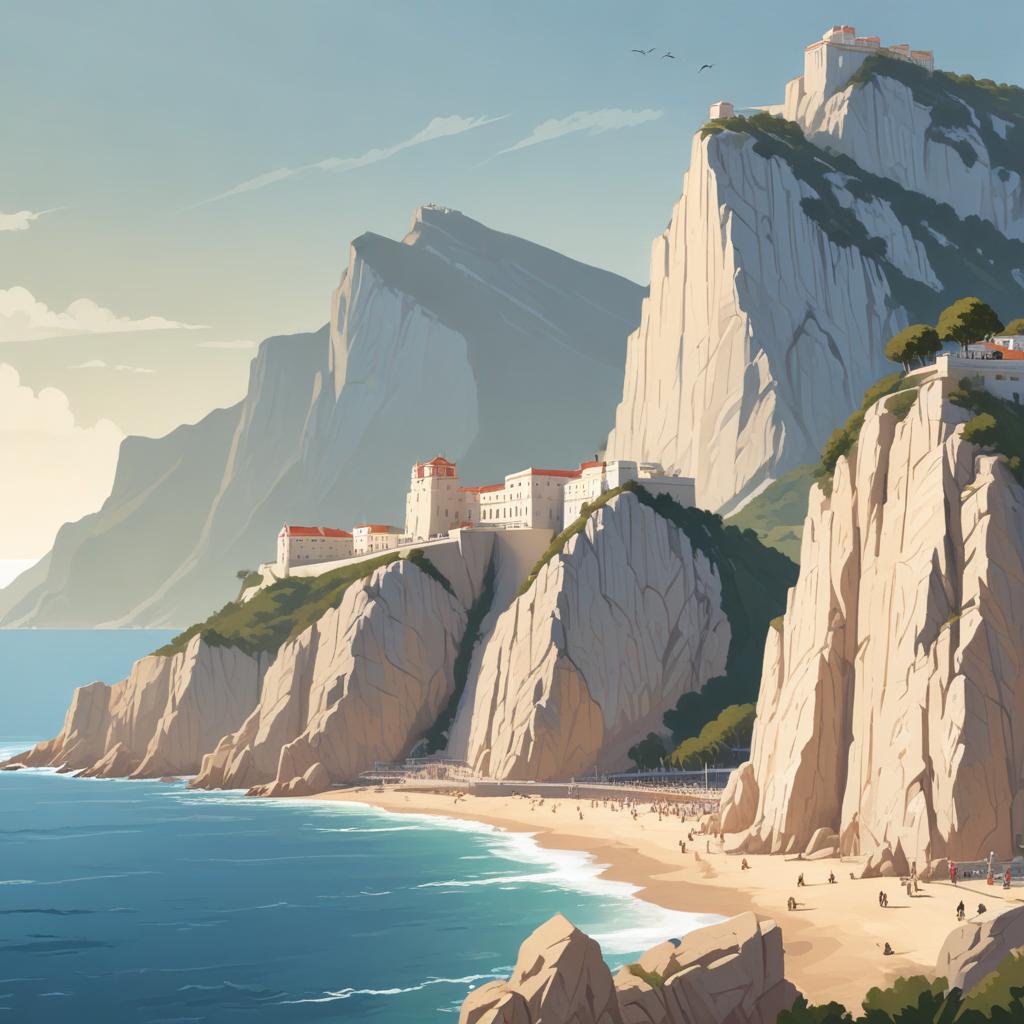
Introduction to Gibraltar’s History
Gibraltar history holds a unique place in the tapestry of global events, blending rich cultural influences and strategic importance. This British Overseas Territory, located at the southern tip of the Iberian Peninsula, serves as a significant gateway between the Atlantic Ocean and the Mediterranean Sea. Geographically, Gibraltar’s position has made it a sought-after stronghold for centuries, as it controls access to one of the world’s busiest maritime routes.
The historical significance of Gibraltar is deeply rooted in its strategic location. Over the ages, it has been a pivotal military base, facilitating control over naval traffic and trade between Europe and Africa. Gibraltar history is layered with episodes from various cultures, including the Moors, Spanish, and British, each leaving their mark on the territory’s identity. This blend of cultures creates a fascinating overview of Gibraltar’s past, showcasing its role as a melting pot of civilizations.
Throughout its history, Gibraltar has witnessed numerous sieges, battles, and treaties, shaping not only its own destiny but also impacting wider geopolitical dynamics. Its importance during the World Wars as a naval base reinforced Gibraltar’s standing on the world stage. Today, understanding Gibraltar history provides valuable insight into its ongoing role as a strategic and culturally rich enclave.
In summary, this introduction offers a brief overview of Gibraltar’s historical significance and geographic location. Exploring Gibraltar history reveals the intertwined stories of conquest, defense, and cultural integration that define this remarkable territory. Its location at the crossroads of continents and seas continues to be a cornerstone of its identity and importance in global affairs.
Ancient and Medieval History
The history of ancient Gibraltar is a fascinating journey through time, revealing the significance of this strategic location from its earliest known settlements to the developments of the medieval era. Archaeological evidence suggests that Gibraltar’s earliest inhabitants date back to prehistoric times, with Neanderthal fossils discovered in the famous Gorham’s Cave, highlighting its role as a refuge for ancient humans.
As an ancient Gibraltar settlement, the area was prized for its natural harbors and commanding position at the entrance to the Mediterranean Sea. The Rock of Gibraltar itself was an important landmark for various civilizations, including the Phoenicians, who are believed to have established early trading outposts in the area. These early settlements laid the foundation for Gibraltar’s long history as a crossroads of cultures and commerce.
During the classical antiquity period, Gibraltar continued to grow in importance. The Romans, recognizing its strategic value, occupied the region and included it in the province of Hispania. The Rock was historically known as one of the Pillars of Hercules—a symbol of the edge of the known world at that time—which gave it a legendary status in ancient mythology and geography.
The medieval era brought significant changes to Gibraltar’s development, as it became a coveted prize among different powers vying for control over the western Mediterranean. The Moors seized the territory in the early 8th century and held it for several centuries, fortifying Gibraltar and enriching its cultural landscape with Islamic influences. This period saw the town flourish as a military stronghold and a trading hub, connecting the Iberian Peninsula with North Africa and beyond.
Later in the medieval era, as Christian forces reconquered parts of the Iberian Peninsula during the Reconquista, Gibraltar’s strategic significance persisted. The town changed hands multiple times, reflecting the turbulent political landscape of the period. Each ruling power left its mark, contributing to the unique blend of architecture, culture, and history that characterizes Gibraltar today.
In summary, the ancient and medieval history of Gibraltar is defined by its earliest settlements and persistent strategic importance. From prehistoric caves to Moorish fortresses, these stages in Gibraltar’s past laid the groundwork for its enduring legacy as a fortress and melting pot of cultures at the gateway to the Mediterranean.
Prehistoric and Ancient Times
Gibraltar’s history extends deep into prehistoric times, with archeological findings revealing evidence of early human habitation that dates back hundreds of thousands of years. The famous Gorham’s Cave, for instance, is one of the last known habitations of the Neanderthals, showcasing tools and remains that provide invaluable insight into prehistoric Gibraltar. These findings confirm the strategic importance of the Rock even in ancient eras, serving as a refuge and vantage point for early human civilizations.
As time progressed, Gibraltar became a nexus for several ancient civilizations, each leaving an indelible mark on its cultural and historical landscape. Among these, the Phoenicians played a significant role. Renowned as master seafarers and traders, the Phoenicians are believed to have used Gibraltar as a critical waypoint in their Mediterranean trading routes. Their influence is evidenced by artifacts and ruins found throughout the area, suggesting that Gibraltar was an important outpost that facilitated commerce and cultural exchange between Africa and Europe.
The presence of such ancient civilizations highlights Gibraltar’s long-standing importance in regional history, weaving together stories from prehistoric times to the age of early Mediterranean empires. Each layer of archaeological discovery enriches our understanding of how prehistoric Gibraltar evolved into a hub for ancient cultures like the Phoenicians, who shaped its early historical identity.
Medieval Rule and Influence
During the medieval period, Gibraltar experienced significant shifts in control and influence, notably marked by the Moorish period and the Christian Reconquista. The strategic location of Gibraltar made it a prized possession for various powers seeking dominance over the entrance to the Mediterranean Sea. The Moorish period began in the early 8th century when Muslim forces conquered the Iberian Peninsula, including Gibraltar. Under Moorish control, Gibraltar became an important military and trading post. The Moors fortified the Rock and established a thriving community influenced by Islamic culture, architecture, and governance.
This era saw the blending of cultures and an expansion of Gibraltar’s significance in regional politics and commerce. However, the Christian Reconquista, a centuries-long series of campaigns by Christian kingdoms to reclaim territory from Muslim rulers, eventually reached Gibraltar. In 1309, the Kingdom of Castile successfully captured Gibraltar from the Moors, marking a pivotal moment in its medieval history. The reconquest was essential not only for the symbolic victory over Muslim rule but also for controlling this key maritime gateway.
The medieval Gibraltar landscape was thus shaped by the contrasting influences of its Moorish rulers and the Christian forces that overtook them. Its medieval history reflects the broader struggles of the Iberian Peninsula, highlighting Gibraltar’s role as a cultural and military crossroads during one of the most turbulent periods in Spanish history.
Modern History and Strategic Importance
The story of modern Gibraltar is deeply intertwined with British rule, which began in the early 18th century. The pivotal moment came in 1704 during the War of the Spanish Succession when an Anglo-Dutch fleet captured Gibraltar from Spain. This event marked the start of British sovereignty over the territory, which was later formalized in the Treaty of Utrecht in 1713. Since then, Gibraltar has remained a British Overseas Territory, solidifying its place as a strategic military and geopolitical asset for the British Empire and later for the United Kingdom.
Gibraltar’s strategic location at the entrance to the Mediterranean Sea has made it a prized possession throughout modern history. Control over this small but vital peninsula allowed Britain to dominate naval traffic through the Strait of Gibraltar, a crucial chokepoint linking the Atlantic Ocean and Mediterranean Basin. This control proved indispensable during times of conflict, especially in the 18th, 19th, and 20th centuries, when maritime power was key to global influence and colonial dominance.
Throughout its modern history, Gibraltar has played a crucial role as a military fortress and naval base. Its natural geography, with steep cliffs and a high rock, was enhanced by extensive fortifications and tunnels developed under British rule. These defenses made Gibraltar an exceptionally stronghold, guarding the western gateway to the Mediterranean. During World War II, Gibraltar’s military significance was at its peak; it served as a vital base for the Allied forces, providing control of naval operations and a staging area for campaigns in North Africa and Southern Europe.
Today, modern Gibraltar continues to hold military significance, though its role has evolved with changing geopolitical dynamics. The territory still hosts a strategic naval base and radar installations that contribute to NATO maritime surveillance and defense. Its location remains key to monitoring naval traffic and ensuring security at one of the busiest maritime corridors in the world. Beyond military aspects, Gibraltar’s strategic location influences its economic life and international relations, maintaining its importance in geopolitics as a bridge between Europe and Africa.
In summary, Gibraltar’s transition to British rule transformed it into a military bastion with enduring strategic importance. From the early 18th century to the present day, its position at the crossroads of continents and seas has ensured its place as a key player in regional and global military history and geopolitics. The legacy of British control has shaped modern Gibraltar’s identity as both a symbol of military strength and a beacon of strategic influence in the Mediterranean region.
British Capture and Territory Changes
In 1704, Gibraltar was captured by a combined Anglo-Dutch fleet during the War of the Spanish Succession. The British capture marked a pivotal moment in Gibraltar’s territorial history. This strategic fortress, located at the entrance to the Mediterranean Sea, was seized from Spanish control by forces loyal to the Habsburg claimant to the Spanish throne. The British recognized the immense military and naval value of Gibraltar, establishing a stronghold that enabled them to control naval traffic through the region.
The significance of the British capture was solidified by the Treaty of Utrecht in 1713. This treaty formally ended hostilities between the major European powers and included a clause that ceded Gibraltar to Great Britain. Importantly, the Treaty of Utrecht established British sovereignty over Gibraltar but did not transfer sovereignty over the surrounding waters, leading to ongoing disputes. The treaty allowed Britain to maintain control over the territory indefinitely, influencing Gibraltar’s political and cultural development.
As a result, Gibraltar became a key naval base and symbol of British power in the Mediterranean. The British capture and subsequent ratification by the Treaty of Utrecht are central to understanding Gibraltar’s complex territorial history. This legacy continues to shape the region’s geopolitical landscape, with the territory remaining a British Overseas Territory to this day.
Gibraltar in 20th and 21st Century
During the 20th century, Gibraltar played a crucial strategic role, particularly throughout World War II. Its location at the entrance to the Mediterranean Sea made it a pivotal military base for the Allies, controlling naval traffic and serving as a fortress against Axis powers. The Rock of Gibraltar was heavily fortified with tunnels, gun emplacements, and airfields to support Allied operations. The civilian population was largely evacuated to reduce risks during bombings, underscoring the territory’s military significance. Post-war, Gibraltar continued to serve as a key British naval base during the Cold War era.
In contemporary times, Gibraltar retains a unique status as a British Overseas Territory. It possesses a high degree of self-governance with its own government and legal system, while defense and foreign policy remain under British control. Despite ongoing disputes with Spain over sovereignty, Gibraltar enjoys economic prosperity driven by sectors such as tourism, finance, and shipping. Its current status reflects a blend of historical legacy and modern development, making it a distinctive entity within Europe.

I have always been captivated by the unique cultural tapestry of the Rock, particularly how Moorish, Spanish, and British influences shaped its development over centuries. My passion lies in translating these complex historical narratives into engaging educational resources that make Gibraltar’s past accessible to everyone. I spend my free time exploring military fortifications and reading first-hand accounts of life at the Pillar of Hercules.