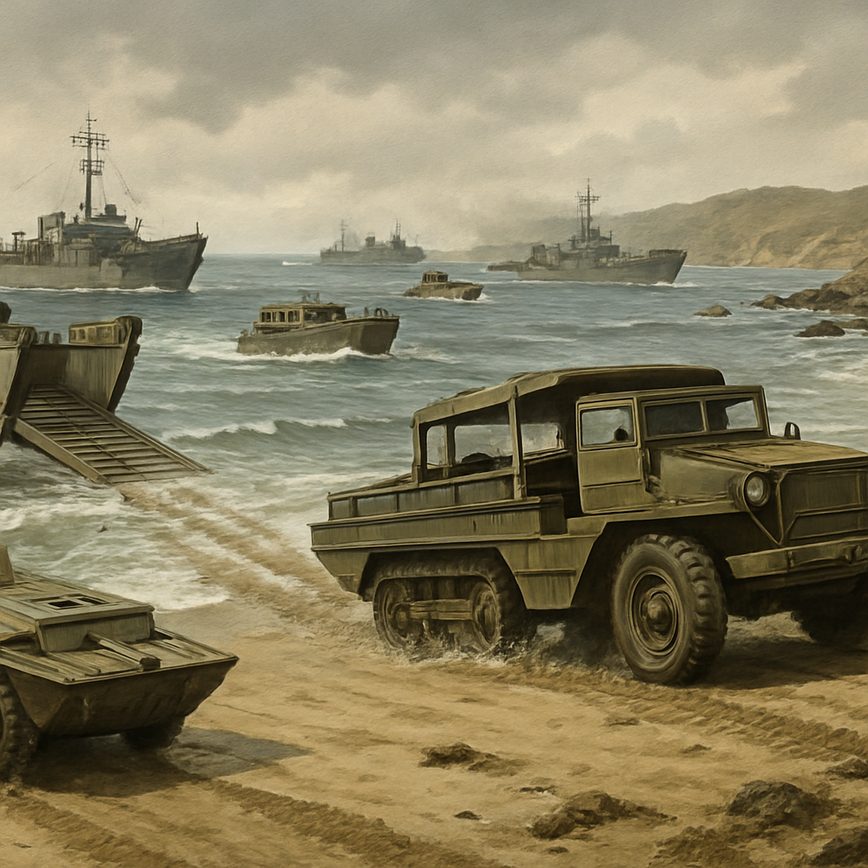
Overview of Operation Torch
Operation Torch was a pivotal Allied invasion during World War II, marking the first major offensive by American forces on the European-North African front. Launched in November 1942, the operation involved a coordinated amphibious assault aimed at gaining control of French North Africa, including key territories such as Morocco and Algeria. The objectives of Operation Torch were multifaceted, seeking not only to open a new front against Axis forces but also to secure strategic ports and airfields to support subsequent military campaigns.
The strategic importance of Operation Torch cannot be overstated. By securing North Africa, the Allies aimed to relieve pressure on the Soviet Union, which was bearing the brunt of the fight against Nazi Germany on the Eastern Front. Additionally, controlling North Africa provided the Allies with a crucial launching point for an eventual invasion of Southern Europe, specifically Italy and later continental Europe. This operation was a significant step in weakening Axis control in the Mediterranean region and disrupting their supply lines.
Operation Torch was also significant for its demonstration of Allied cooperation, involving British and American forces working in unison towards a common goal. The successful landings along the North African coast opened the door for the eventual defeat of Axis forces in the region. Moreover, it paved the way for the Casablanca Conference, where Allied leaders would plan further war strategy. Overall, the operation was a strategic turning point in the North African campaign, symbolizing a shift in momentum towards the Allied forces during WWII.
In summary, Operation Torch was more than just an invasion; it was a carefully planned and executed military campaign that played a critical role in the Allied efforts during World War II. By achieving control over French North Africa, the operation not only challenged Axis dominance but also laid the foundation for future Allied successes in Europe and the Mediterranean, underscoring its vital role in the broader context of the war.
Planning and Objectives
The planning process of Operation Torch was a complex endeavor that involved extensive coordination between the Allied powers. Military strategists focused on devising a strategy that would enable a swift and decisive victory while minimizing casualties and logistical challenges. The operation planners paid special attention to coordination between naval, air, and ground forces, ensuring seamless communication and synchronized movements.
One of the primary objectives of Operation Torch was to gain control of key strategic points in North Africa, including the vital port of Gibraltar. This location was essential for securing Allied naval dominance in the Mediterranean and facilitating further operations against Axis forces. The planners aimed to weaken Axis powers by cutting off their supply lines, reducing their territorial holdings, and establishing a strong Allied presence in the region.
Another key objective was to boost the morale of Allied forces and demonstrate their capability to launch large-scale amphibious assaults. Operation Torch was also intended to ease pressure on the Soviet Union by opening a second front, allowing Allied forces to engage Axis troops on multiple fronts. The meticulous planning process balanced these military strategy goals with the practicalities of executing a coordinated, multinational campaign that would lay the groundwork for the eventual liberation of Europe.
Forces Involved and Key Leaders
Operation Torch was a significant Allied military endeavor involving a combination of land, sea, and air forces. The main military forces comprised units from the United States and the United Kingdom, reflecting the joint effort to establish a strong foothold in North Africa. The American Western Task Force sailed from the United States and was primarily responsible for the landings in Morocco, while the British Eastern and Central Task Forces targeted Algeria. These forces included seasoned infantry, armored divisions, naval fleets, and air squadrons prepared to execute coordinated assaults against Vichy French positions.
Key leaders played a crucial role in the planning and execution of this complex operation. General Dwight D. Eisenhower served as the overall Allied commander, orchestrating the various components of the assault and ensuring cooperation among the multinational forces. Under his leadership, Lieutenant General George S. Patton commanded the Western Task Force, leading American troops during the initial landing in Morocco. On the British side, General Sir Harold Alexander was instrumental in directing the Eastern and Central Task Forces aiming at Algeria. Naval operations were overseen by Admiral Sir Andrew Cunningham, responsible for securing sea routes and protecting landing forces from Axis naval threats.
The collaboration of these Allied commanders, along with the deployment of substantial military forces, was pivotal to the success of Operation Torch. Their strategic coordination not only secured critical territories but also marked the beginning of a larger campaign that would eventually lead to the liberation of North Africa from Axis control.
Strategic Importance of Gibraltar in Operation Torch
Gibraltar’s strategic location at the southern tip of the Iberian Peninsula made it a pivotal point during Operation Torch, the Allied invasion of North Africa in World War II. Its position controls the entrance and exit to the Mediterranean Sea via the Strait of Gibraltar, one of the world’s most crucial naval chokepoints. This narrow passage allowed the Allies to monitor and regulate naval traffic between the Atlantic Ocean and the Mediterranean, making Gibraltar invaluable for the success of the operation.
As a fortified British territory, Gibraltar served as a vital naval base from which the Allies could project power into the Mediterranean theater. Its deep-water ports and extensive military infrastructure enabled the Allies to dock warships, repair vessels, refuel fleets, and coordinate naval operations efficiently. This naval hub played a crucial role in securing sea lanes and ensuring the uninterrupted flow of troops and supplies essential for Operation Torch’s amphibious landings along the North African coast.
The geographical features of Gibraltar, including its imposing Rock and fortified defenses, provided a natural stronghold that was easily defensible against Axis naval and air attacks. This made it a secure staging ground for launching coordinated attacks and protecting convoys heading eastward. Additionally, Gibraltar’s proximity to the African coast reduced transit times for Allied forces, allowing for quicker deployment and greater operational flexibility during the complex amphibious assault.
Control of Gibraltar also allowed the Allies to impose a naval blockade on Axis forces, cutting off their reinforcements and supply routes across the Mediterranean. The naval base enabled the launch of reconnaissance missions and antisubmarine operations, safeguarding Allied shipping from enemy submarines and surface raiders. This containment strategy was crucial in weakening Axis resistance and ensuring the success of the North African campaign.
In summary, Gibraltar’s strategic location and its naval base were instrumental in the planning and execution of Operation Torch. Its command over the gateway to the Mediterranean, combined with its fortified defenses and logistical capabilities, made it a cornerstone of Allied operations in North Africa. The control of Gibraltar not only secured vital maritime routes but also reinforced the Allied presence in the Mediterranean, significantly contributing to the operation’s ultimate success.
Gibraltar as a Naval and Air Base
Gibraltar played a crucial role as both a naval base and an air operations hub during Operation Torch, significantly supporting the Allied invasion. Its strategic location at the entrance to the Mediterranean Sea made it an indispensable asset for controlling maritime routes and ensuring the safe passage of Allied naval forces. The naval base provided a secure harbor for fleet repair, resupply, and coordination of naval maneuvers, which were vital to the success of the amphibious landings in North Africa.
In addition to its naval significance, Gibraltar was essential for air operations. The airfields on the Rock allowed the Allies to launch reconnaissance missions, provide air cover, and conduct bombing raids to weaken Axis defenses ahead of the landings. These air operations were crucial for protecting the invasion forces from enemy attacks and for disrupting Axis supply lines. Gibraltar’s facilities also served as a staging ground for Allied aircraft, enabling rapid deployment and rotation of aircrews during the campaign.
The combined capabilities of Gibraltar as a naval and air base allowed the Allies to maintain a strong presence in the region, ensuring effective coordination and support throughout Operation Torch. This made it a linchpin in the broader strategy to open a new front against Axis powers, contributing decisively to the eventual Allied victories in North Africa.
Logistical Support and Supply Routes
Gibraltar played a crucial role in enabling logistical support and securing supply routes for Operation Torch, the Allied invasion of North Africa during World War II. Its strategic position at the entrance to the Mediterranean Sea allowed the Allies to establish a vital naval base and a secure staging area from which they could coordinate and dispatch troops, equipment, and supplies. This significantly enhanced the logistics chain, ensuring that the flow of resources to the front lines was both efficient and protected from Axis interference.
The port of Gibraltar was equipped to accommodate a large number of military vessels, including troop transports, supply ships, and warships. This allowed for the rapid unloading and redistribution of war materiel, which was essential to maintaining the momentum of Allied operations. The secure harbor and nearby facilities also facilitated repairs, resupply, and refueling, making sure Allied forces were combat-ready at all times.
Moreover, the control of Gibraltar ensured safe supply routes through the Mediterranean, which had been threatened by Axis naval and air power. By holding Gibraltar, the Allies were able to protect convoys from U-boat attacks and aerial bombardment, thereby maintaining a reliable chain of logistics crucial for the success of Operation Torch. This robust logistical network not only supported immediate military needs but also laid the groundwork for future Allied advances across North Africa and into Southern Europe.
Outcomes and Impact on World War II
Operation Torch marked a pivotal moment in the Allied victory during World War II, fundamentally altering the trajectory of the North Africa campaign and the broader conflict. Launched in November 1942, this ambitious amphibious assault by American and British forces aimed to secure key French territories in North Africa from Axis control. The operation’s outcomes not only achieved this immediate military goal but also set the stage for subsequent Allied advances that would help tip the balance in the Allies’ favor.
One of the most significant outcomes of Operation Torch was the successful establishment of a new front in North Africa, which relieved pressure on the Soviet Union by forcing Germany to divert troops and resources away from the Eastern Front. This strategic dispersal of Axis forces weakened their overall operational effectiveness. Furthermore, the victory in North Africa secured vital supply routes across the Mediterranean, enhancing the Allies’ logistical capabilities and facilitating the movement of troops and materials for future campaigns.
The North Africa campaign, bolstered by the success of Operation Torch, paved the way for the Allied invasion of Sicily and subsequently mainland Italy. These offensives progressively dismantled Axis control in Southern Europe. The collaboration and coordination demonstrated during Torch also strengthened the alliance and military partnership between the United States and the United Kingdom, showcasing effective joint planning and execution that would be crucial in later operations such as D-Day.
Beyond the immediate military effects, Operation Torch had significant political ramifications. It helped sway the allegiance of Vichy French forces in North Africa, minimizing resistance and facilitating smoother occupation by Allied troops. This shift not only diminished Axis influence in the region but also bolstered Allied diplomatic efforts and legitimacy in coordinating multi-national war efforts.
In summary, the outcomes of Operation Torch were transformative for the course of World War II. The campaign accelerated the Allied victory by securing North Africa, enabling subsequent Mediterranean operations, and splitting Axis attention across multiple fronts. Its success was a vital step toward the ultimate defeat of Axis powers and highlighted the importance of strategic coordination and bold military action in shaping the Allied war effort.
Effect on Axis and Allied Forces
Operation Torch had a significant effect on both Axis and Allied forces in the North African theater. For the Axis powers, the Allied landings in Morocco and Algeria forced a strategic realignment and stretched their already thin resources. The operation marked the beginning of a sustained Allied advance that put continuous pressure on Axis defenses, eventually leading to their gradual retreat. The defeat in this campaign weakened the Axis hold on North Africa and disrupted their supply lines, causing logistical difficulties and lowering morale among the troops.
On the Allied side, Operation Torch was a crucial turning point. It enabled a two-pronged assault alongside the British forces already engaged in Egypt and Libya, facilitating a pincer movement against Axis positions. This coordinated pressure accelerated the collapse of Axis resistance in the region, paving the way for subsequent victories such as the Battle of Tunisia. The success of Operation Torch also boosted Allied confidence and demonstrated the effectiveness of multinational cooperation. By opening up a new front, the Allies gained strategic momentum and set the stage for the eventual liberation of North Africa from Axis control.
Ultimately, the operation shifted the balance in the North African theater, transforming the Axis defeat into a decisive Allied advance that contributed substantially to the overall progress of the Allied war effort in World War II.
Long-term Significance of Gibraltar Post-Operation
Following Operation Torch, Gibraltar’s military significance did not diminish; rather, the base continued to play a critical role throughout the remainder of World War II and beyond. Its strategic location at the entrance to the Mediterranean Sea allowed the Allies to control naval traffic between the Atlantic Ocean and the Mediterranean, ensuring a vital supply route for troops and materials. This post-war significance was instrumental in maintaining dominance over the region and guarding against Axis naval movements.
The Gibraltar base became a hub for military operations, surveillance, and intelligence gathering. Its natural fortress and advanced fortifications were enhanced to support ongoing defense strategies, making it a linchpin in the Allies’ military strategy. The ability to project naval power from Gibraltar helped to secure key Mediterranean islands and facilitated successful campaigns in North Africa and Southern Europe. This strategic outpost provided the Allies with a secure location to repair, refuel, and resupply warships, which was critical in sustaining prolonged naval engagements.
Additionally, Gibraltar’s role extended into the post-war period, as it remained a vital listening and observation post during the early stages of the Cold War. Its continued importance in military strategy highlighted the enduring value of its geographic positioning. Thus, Gibraltar’s legacy after Operation Torch underscores how this base was not only pivotal during the war but also shaped military strategy in the decades that followed.

I have always been captivated by the unique cultural tapestry of the Rock, particularly how Moorish, Spanish, and British influences shaped its development over centuries. My passion lies in translating these complex historical narratives into engaging educational resources that make Gibraltar’s past accessible to everyone. I spend my free time exploring military fortifications and reading first-hand accounts of life at the Pillar of Hercules.