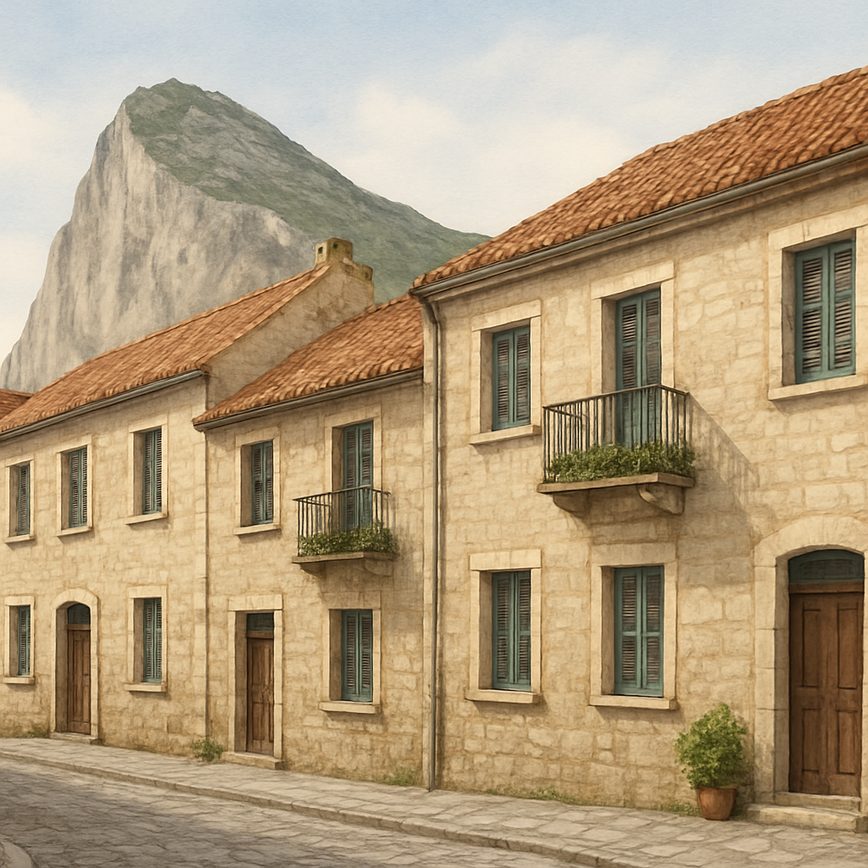
Historical Overview of Gibraltar Housing
The Gibraltar housing history reflects a unique blend of various cultural and architectural influences shaped by the strategic importance of this small peninsula at the entrance to the Mediterranean. From its early days as a natural fortress, Gibraltar’s housing evolution has been deeply intertwined with its military and maritime significance, undergoing significant transformations from primitive shelters to modern urban residences.
In ancient times, Gibraltar was sparsely inhabited, with early settlers living in natural caves and simple stone structures. The rocky landscape limited extensive housing development, and most inhabitants were transient fishermen or small communities relying on the sea for sustenance. The historical development of Gibraltar housing began to gain momentum following the Moorish occupation in the 8th century, which introduced fortified elements and modest urban planning.
The turning point in the housing evolution came after the capture of Gibraltar by Anglo-Dutch forces in 1704. The British military presence drastically influenced the architectural style and construction methods. Housing development primarily served military needs, with barracks, officers’ quarters, and fortifications dominating the landscape. Civilian housing during this period was modest and often cramped, reflecting the priority given to defense rather than residential comfort.
Throughout the 18th and 19th centuries, the population grew steadily, driven by a combination of military personnel, merchants, and displaced peoples from nearby regions. This growth spurred the expansion of housing beyond the military areas, resulting in the establishment of mixed-use neighborhoods with a distinctive architectural tapestry. Narrow streets lined with terraced houses and Mediterranean-style homes became characteristic of Gibraltar’s urban layout.
The 20th century introduced new challenges and opportunities for Gibraltar housing. With World War II prompting evacuations and bomb damage, post-war reconstruction efforts focused on modernizing infrastructure while preserving historical elements. Social housing projects emerged, aiming to improve living conditions for the working class, accompanied by the construction of larger apartment complexes and civic buildings.
Today, the historical development of Gibraltar housing reflects a balance between preserving the rich cultural heritage and accommodating modern living standards. Contemporary Gibraltar features a blend of restored historical homes and cutting-edge residential developments, illustrating an ongoing evolution shaped by past legacies and current urban demands. This trajectory highlights the unique narrative of Gibraltar’s housing history as both a product of its strategic significance and the resilience of its community.
Housing during British Military Control
The British military presence in Gibraltar significantly shaped the housing development and architectural design in the territory. As Gibraltar became a critical military stronghold, the need for secure and strategically located housing for soldiers and their families influenced construction practices. Housing during this period was built with an emphasis on defense and functionality, often incorporating fortifications into the design to withstand potential attacks.
Military barracks and officers’ quarters were strategically positioned near key fortifications, providing quick access to defensive positions. These structures were robustly constructed, using durable materials to protect inhabitants and ensure long-term resilience. The design of residential areas often reflected military discipline and order, with buildings arranged in neat, regimented layouts that supported efficient movement and communication among troops.
The British military’s influence also meant that traditional civilian housing was sometimes adapted or repurposed to meet military needs. This included enhanced security features such as reinforced doors and windows, as well as proximity to military installations for surveillance and rapid response. In essence, the housing development under British control was a blend of residential utility and military practicality, ensuring that Gibraltar remained a fortified enclave while providing livable spaces for its inhabitants.
Civilian Housing Growth in the 20th Century
The 20th century marked a significant period of expansion for civilian housing in Gibraltar, characterized by urban expansion that responded to the island’s growing population and economic development. As military functions that previously dominated the area diminished, land previously reserved for defense purposes became available for civilian residences. This transition was pivotal in accommodating the increasing demand for housing caused by both natural population growth and an influx of workers drawn to emerging industries and services.
Throughout the century, the push for civilian housing was influenced by several factors. The rise of tourism and trade brought increased prosperity and the need for a stable workforce, prompting urban planners to develop new residential neighborhoods. Additionally, improvements in infrastructure, such as roads and utilities, facilitated the expansion of housing beyond the traditional town center, promoting the creation of suburbs and satellite communities.
Government policies and investment also played a crucial role in encouraging residential growth. Public housing projects, aimed at improving living conditions and addressing shortages, became prominent in the mid-1900s. These efforts were complemented by private developments that catered to different socio-economic groups, contributing to a diverse and expanding urban landscape.
In summary, the 20th century saw Gibraltar’s civilian housing sector evolve dramatically, driven by urban expansion fueled by population pressures, economic opportunities, and strategic shifts in land use. This growth not only reshaped the physical environment but also laid the foundation for the modern residential communities that define Gibraltar today.
Architectural Styles and Influences in Gibraltar Housing
The architectural styles found in Gibraltar housing are a captivating blend that reflects the region’s rich history and cultural diversity. This unique blend has evolved over centuries, shaped by various cultural influences that have left their mark on Gibraltar’s built environment. Understanding Gibraltar housing design requires exploring the primary architectural styles and the influences behind them.
One of the most prominent architectural styles in Gibraltar is the Mediterranean style. Characterized by whitewashed walls, red-tiled roofs, and wrought-iron details, this style is influenced heavily by the proximity to southern Spain and the broader Mediterranean basin. The Mediterranean style emphasizes simplicity, earth-toned colors, and indoor-outdoor living spaces, which suit Gibraltar’s mild climate. Many traditional homes incorporate courtyards and terraces that reflect the local lifestyle and adaptation to the environment.
In addition to Mediterranean influences, British colonial architecture has played a crucial role in shaping Gibraltar housing design. As a British Overseas Territory, Gibraltar features elements such as Georgian and Victorian styles, evident in the symmetry, sash windows, and brickwork seen in older residential buildings. These British architectural features merged with local traditions creating a distinctive hybrid style unique to Gibraltar.
Another vital influence is Moorish architecture, which is visible in some decorative elements and residential layouts. The Moorish legacy, dating back to when Gibraltar was under Muslim rule, contributes to features such as intricately designed tiles, arches, and ornamental ironwork. This influence blends harmoniously with Mediterranean elements to provide a rich cultural tapestry in the housing design.
The blend of Spanish, British, and Moorish styles also extends to modern Gibraltar housing developments, reflecting a contemporary interpretation of traditional designs. New constructions often incorporate sustainable materials while paying homage to these cultural influences, maintaining the historical aesthetic while embracing modern needs.
Overall, the architectural styles and influences in Gibraltar housing showcase how diverse cultural interactions over centuries have shaped the area’s housing design. This fusion of Mediterranean, British colonial, and Moorish styles creates a distinctive architectural identity that continues to define Gibraltar’s residential character today.
Mediterranean and Moorish Influences
The traditional housing styles in Gibraltar bear significant marks of Mediterranean architecture and Moorish design, reflecting the region’s rich cultural history and strategic geographical location. Mediterranean architecture in Gibraltar is characterized by its use of whitewashed walls, terracotta roof tiles, and open courtyards, which create homes that are not only visually appealing but also well-suited to the warm climate. These elements help regulate indoor temperatures and foster a connection with outdoor living spaces, a hallmark of Mediterranean housing styles.
Moorish design principles further enrich Gibraltar’s housing heritage, with intricate geometric patterns, decorative tile work, and archways prominently featured in many historic residences. The influence of Moorish design is seen in the detailed craftsmanship and ornamental aesthetics that provide both function and artistry. This blend of Mediterranean and Moorish elements results in homes that combine practical living solutions with cultural expression, making Gibraltar’s housing styles unique in the region.
Overall, the integration of Mediterranean architecture and Moorish design in Gibraltar traditional housing signifies a harmonious fusion of different cultural influences. The architectural legacy serves not only as a testament to Gibraltar’s historical connections across the Mediterranean basin but also continues to shape the visual and functional identity of its residential buildings today.
British Colonial and Modernist Impact
The architectural landscape of Gibraltar underwent significant transformation during the British colonial era and the subsequent modernist period. British colonial architecture introduced a distinctive style that blended practical military needs with residential comfort, marking a departure from earlier local traditions. This period saw the construction of robust, utilitarian buildings characterized by symmetry, sash windows, and classical details, designed to accommodate the strategic importance of the territory while adapting to its unique environment. These structures laid the foundation for Gibraltar’s evolving urban fabric.
As the 20th century progressed, modernist housing emerged, reflecting broader global trends in design evolution. This movement emphasized simplicity, functionality, and the use of new materials and construction techniques. Modernist housing in Gibraltar introduced clean lines, geometric forms, and open-plan interiors, contrasting sharply with the ornate colonial style. The shift towards modernist design represented a response to changing social needs, increased population, and technological advancements, fostering more efficient and affordable living spaces.
Together, British colonial architecture and modernist housing illustrate a dynamic journey in Gibraltar’s housing history, highlighting both continuity and change. This evolution underscores how architectural styles serve as markers of cultural identity and adaptation, shaping the built environment in ways that reflect historical and societal transformations.
Current Trends and Future of Housing in Gibraltar
Gibraltar’s housing market has seen notable shifts in recent years, shaped by the territory’s unique geographical constraints and evolving socio-economic landscape. One of the most prominent housing trends is the increasing demand for innovative residential solutions that optimize limited space. With Gibraltar’s land scarcity, new developments emphasize vertical expansion and mixed-use complexes that combine living, working, and recreational spaces within compact footprints. This approach not only addresses space limitations but also promotes a more integrated urban lifestyle.
Another key trend is the growing focus on sustainability in housing developments. Recent projects incorporate energy-efficient building materials and technologies to reduce environmental impact and improve living conditions. Solar panels, improved insulation, and water-saving fixtures are becoming standard in new constructions, aligning Gibraltar with global movements towards greener urban living.
Affordability remains a critical challenge for many residents. The government and private sectors are increasingly collaborating to introduce affordable housing schemes aimed at first-time buyers and low to middle-income families. Subsidized housing initiatives and shared ownership models play a pivotal role in making housing accessible while maintaining quality standards.
Looking towards the future housing landscape of Gibraltar, urban planning efforts are set to prioritize smart city concepts and digital infrastructure integration. These plans envision technologically advanced residential areas equipped with smart meters, automated systems, and high-speed connectivity, enhancing residents’ quality of life and overall efficiency.
Planners are also paying increased attention to public spaces and community facilities, ensuring that housing developments contribute to social cohesion and well-being. Green spaces, pedestrian-friendly walkways, and accessible transport links are integral elements of future urban projects, fostering a balanced and healthy urban environment.
In conclusion, the housing trends in Gibraltar illustrate a dynamic and adaptive market responding to spatial limits, environmental responsibilities, and socio-economic needs. The future of housing here will likely be characterized by innovative design, sustainability, affordability, and smart urban planning, ensuring that Gibraltar remains a livable and vibrant community despite its geographical challenges.
Affordable Housing Initiatives
The government of Gibraltar has implemented several initiatives designed to expand the availability of affordable housing in response to increasing demand and the rising cost of living. Recognizing the critical need for affordable housing, Gibraltar policies have focused on creating a sustainable approach to meet the needs of local residents, particularly those in lower income brackets and first-time homebuyers.
Key to these efforts are various housing projects that are aimed at increasing the stock of affordable homes through strategic planning and public-private partnerships. These projects are carefully developed to ensure accessibility, affordability, and quality, offering residents a range of housing options that fit their financial situations. The government has also introduced subsidies, grants, and preferential financing schemes to facilitate easier access to these affordable housing units.
Moreover, Gibraltar policies address the challenges of limited land availability by embracing innovative construction methods and efficient land use practices. The government’s commitment to balancing growth with community needs is evident in ongoing and future housing projects, which prioritize long-term affordability and sustainability.
Through continuous evaluation and adaptation of these policies, Gibraltar aims to ensure that every citizen has the opportunity to secure decent, affordable housing, thereby enhancing overall social welfare and economic stability in the territory.
Sustainable and Modern Housing Solutions
In recent years, there has been a significant shift towards sustainable housing as contemporary housing projects increasingly adopt green architecture principles. This transition focuses on reducing environmental impact through the use of energy-efficient materials, renewable energy sources, and innovative technologies that promote sustainability. Modern homes are designed not only to minimize carbon footprints but also to enhance the quality of life for occupants by improving indoor air quality and natural lighting.
Developments now incorporate sustainable building practices such as using recycled and locally sourced materials, installing solar panels, and implementing water-saving systems. The integration of smart home technologies allows residents to monitor and manage energy consumption effectively, further promoting eco-friendly living. These sustainable housing solutions demonstrate a commitment to environmental responsibility while meeting the needs of modern lifestyles.
Green architecture also emphasizes landscaping and planning that supports biodiversity and reduces urban heat islands. Designers and builders are collaborating to create homes that blend harmoniously with the natural environment, ensuring that new developments in Gibraltar preserve the region’s unique ecology. As a result, sustainable and modern homes are becoming a vital part of Gibraltar’s housing history, reflecting a forward-thinking approach to urban development and community well-being.

I have always been captivated by the unique cultural tapestry of the Rock, particularly how Moorish, Spanish, and British influences shaped its development over centuries. My passion lies in translating these complex historical narratives into engaging educational resources that make Gibraltar’s past accessible to everyone. I spend my free time exploring military fortifications and reading first-hand accounts of life at the Pillar of Hercules.