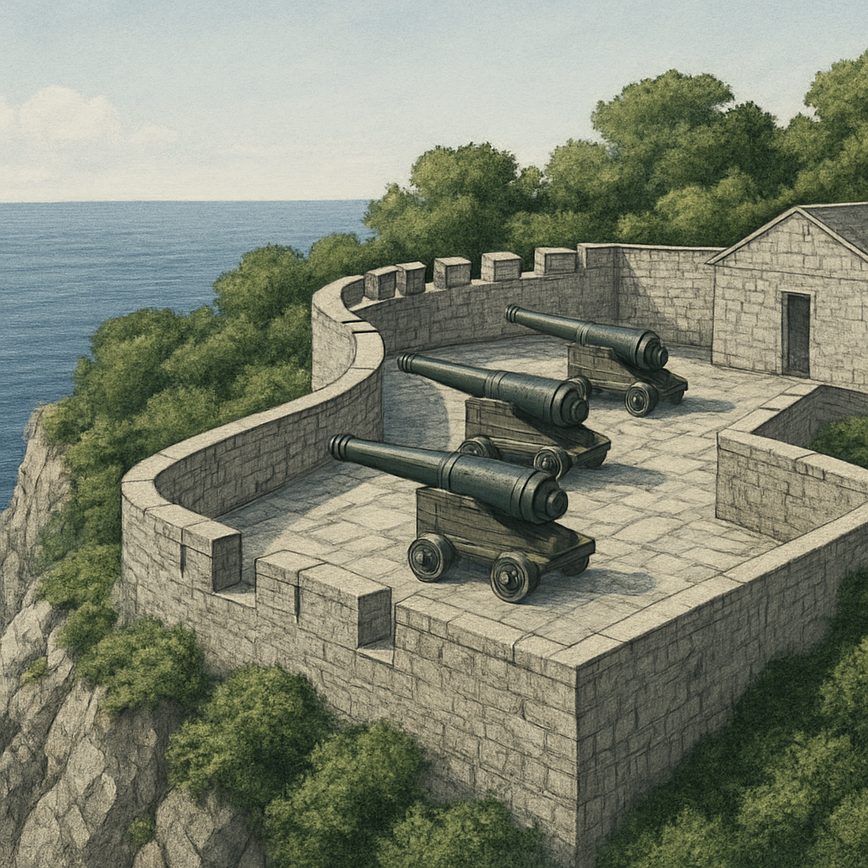
Overview of Princess Caroline’s Battery
Princess Caroline’s Battery is a prominent historic artillery installation located within the British Overseas Territory of Gibraltar. Nestled strategically on the Rock of Gibraltar, this battery forms a critical part of the extensive network of historic fortifications that have shaped the region’s defense history. Positioned to oversee the western approaches to Gibraltar, Princess Caroline’s Battery played a key role in controlling access to the vital maritime passages surrounding the peninsula.
The battery is situated on a commanding elevation that provided its gunners with a clear line of sight over the Bay of Gibraltar and the Strait beyond. This vantage point was essential for the battery’s primary function: to mount artillery aimed at deterring and defending against naval threats. By integrating advanced Gibraltar artillery techniques of its time, Princess Caroline’s Battery contributed significantly to the overall defensive strategy devised to protect this crucial Mediterranean stronghold.
Gibraltar’s historic fortifications, including Princess Caroline’s Battery, stand as a testament to centuries of military engineering and strategic foresight. Over the years, the battery was continuously upgraded and maintained to keep pace with evolving military technology and geopolitical challenges. Its guns were strategically placed to maximize firepower coverage and effectiveness, securing Gibraltar’s position as a formidable bastion against potential invaders.
Today, Princess Caroline’s Battery not only serves as an important relic of Gibraltar’s military past but also offers insight into the broader history of artillery and fortification development in the region. Its preservation allows historians and visitors alike to appreciate the strategic importance of Gibraltar artillery fortifications in safeguarding this pivotal point of interest at the crossroads of Europe and Africa.
Geographical and Strategic Significance
Princess Caroline’s Battery was strategically positioned to maximize its defensive capabilities, playing a crucial role in the military defense framework. Its geography was carefully selected to oversee the key approaches and control vital sea routes. Situated at a vantage point, the battery commanded a wide field of fire over the surrounding waters, allowing it to detect and engage enemy vessels from a considerable distance.
The strategic location of the battery was essential in creating a formidable defense point that protected allied naval and merchant shipping lanes. By controlling these sea routes, the battery hindered enemy movements and safeguarded crucial maritime passages, which were vital for military and trade operations alike. Its placement also ensured the protection of nearby fortifications and harbors, reinforcing the overall defense network.
In essence, the geography of Princess Caroline’s Battery was integral to its role in defense. The elevation and positioning allowed for enhanced surveillance and artillery range, making it a critical defense point against seaborne threats. This strategic advantage contributed significantly to maintaining control over the surrounding sea routes, ensuring security and dominance in the region.
Origin of the Name
Princess Caroline has a significant place in history, especially regarding the naming history of Princess Caroline’s Battery. The battery was named to honor Princess Caroline of Brunswick, who was a prominent royal figure during the late 18th and early 19th centuries. Princess Caroline was well-known not only for her royal connections but also for her turbulent personal life, which captured the public’s attention across Europe.
Her connection to the battery stems from the tradition of naming military installations and important defense structures after members of the royal family to emphasize loyalty and royal endorsement. Princess Caroline, being a notable member of the British royal family as the wife of the future King George IV, was an influential figure and her name carried considerable prestige. This royal connection added a ceremonial and symbolic value to the battery, reflecting its importance in defense and military strategy.
The naming history of Princess Caroline’s Battery is a testament to the era when honoring royalty through such designations was common practice. It served not only as a recognition of the princess herself but also as a reminder of the British crown’s presence and authority in the region. Over time, this royal connection has contributed to the battery’s historical significance and continues to be a point of interest for historians and visitors alike.
Historical Development and Military Use
The construction history of Princess Caroline’s Battery is a testament to the evolving military needs and engineering advancements from the 18th century through the 20th century. Initially established in the early 1700s, the battery was built as part of Gibraltar’s extensive defensive network designed to fortify the Rock against naval and land-based assaults. Its foundation phase involved robust stone masonry and the strategic placement of artillery positions to cover vital approaches to the territory.
Throughout its early years, the battery underwent several key upgrades that reflected the changing nature of warfare. In the mid-18th century, efforts focused on reinforcing gun emplacements, improving ammunition storage facilities, and integrating more powerful cannons capable of longer range and greater accuracy. These modifications not only enhanced the battery’s defensive capabilities but also signaled its increasing importance in the broader military strategy of the region.
During various military engagements, Princess Caroline’s Battery played a pivotal role. It was actively engaged during the Great Siege of Gibraltar (1779-1783), where its artillery helped repel prolonged attacks by Spanish and French forces. The battery’s elevated position afforded a commanding view of enemy movements, allowing defenders to respond swiftly and effectively, which significantly contributed to the successful defense of the Rock.
As artillery technology evolved in the 19th century, the battery saw further modernization to accommodate rifled muzzle loaders and later breech-loading guns. These upgrades included reinforced platforms and new mounting systems designed to absorb recoil and improve firing precision. The battery’s evolution mirrored broader military trends, transitioning from smoothbore cannons to more sophisticated artillery that could address the threats posed by faster and more heavily armed ships.
In the 20th century, especially during both World Wars, Princess Caroline’s Battery continued to serve a critical military purpose. It was adapted for modern warfare with installations of anti-aircraft guns and radar equipment, reflecting the shift from traditional artillery engagements to aerial defense and surveillance. These adaptations ensured that the battery remained a vital component of Gibraltar’s layered defense system, capable of responding to contemporary military challenges.
Today, the battery stands not only as a historical monument but also as a symbol of military resilience and technological progress. Its construction history, military engagements, and continuous battery evolution provide rich insights into the strategic imperatives that shaped the defense of Gibraltar over centuries.
Construction and Early History
Princess Caroline’s Battery was constructed in the 18th century as part of a strategic fortification effort to bolster coastal defenses. The construction period reflected the military engineering techniques of the time, with an emphasis on robust stonework and practical design tailored to withstand both naval bombardments and potential land assaults. The architectural style of the battery was typical of 18th century fortifications, featuring thick, sloped walls to deflect cannon fire and a strategic placement that maximized the field of fire over the surrounding waters.
During its early use, Princess Caroline’s Battery served as a critical defensive point, protecting vital harbor approaches and acting as a deterrent against enemy ships attempting to breach the harbor. The battery’s artillery emplacements were positioned to cover key access channels, allowing defenders to control naval traffic effectively. In its first decades, it was an essential component of the broader fortification system, contributing to the security and control of the territory during a period marked by frequent military conflicts.
The design and initial deployment of the battery reflect the military priorities of the period, emphasizing the strategic importance of coastal fortifications in the 18th century. The structure’s early defensive uses set a precedent for its enduring role in the region’s military history, showcasing the practical application of fortification construction techniques in a constantly evolving geopolitical landscape.
Role in Major Conflicts
Princess Caroline’s Battery played a pivotal role in several major conflicts, most notably during the Siege of Gibraltar. Throughout various wars that swept through the region, its strategic position allowed it to be a critical point of defense and artillery deployment. The battery was equipped with a range of powerful guns designed to control naval approaches and provide overlapping fields of fire with nearby fortifications.
During the lengthy Siege of Gibraltar, its artillery deployment was instrumental in repelling enemy forces attempting to seize control of the fortress. The placement of guns at Princess Caroline’s Battery enabled defenders to deliver sustained and accurate fire, disrupting siege operations and inflicting significant damage on opposing forces. Its effectiveness was reflected in the resilience of Gibraltar’s defenses, as the battery helped maintain control over key maritime routes and prevented enemy landings.
Throughout successive wars, the battery’s role evolved with advancements in artillery technology, adapting to enhanced firepower and changing military tactics. Its continuous upgrading ensured that it remained a formidable defense point, capable of supporting broader military operations within the region. Ultimately, Princess Caroline’s Battery was more than just a static emplacement; it was an active participant in the enduring military history of Gibraltar, distinguished by its strategic importance and effective artillery deployment during crucial sieges and conflicts.
Current Status and Preservation Efforts
Princess Caroline’s Battery, a historic artillery emplacement in Gibraltar, stands today as a well-maintained heritage site reflecting centuries of military history. Though originally constructed during the 18th century, the battery has undergone significant efforts to preserve its structural integrity and historical authenticity. The current condition of the site is excellent, with restoration projects ensuring that the original masonry, cannon placements, and surrounding fortifications remain preserved for future generations.
Ongoing preservation efforts are spearheaded by local heritage organizations in collaboration with the Gibraltar government. These initiatives include careful cleaning, masonry repairs, and the use of conservation techniques designed to protect the battery from natural weathering and the effects of time. Archaeological surveys and research also contribute to understanding the site’s history, informing restoration decisions with accuracy and respect for historical detail.
Today, Princess Caroline’s Battery plays an essential role as both a heritage site and a tourist attraction. It draws visitors interested in Gibraltar’s rich military past, providing insights into strategic defense mechanisms used in historic conflicts. The battery is part of wider heritage trails that highlight Gibraltar’s fortifications, making it a key destination for cultural tourism in the region.
Tourism at the battery has encouraged awareness and funding for its ongoing preservation. Visitor access is carefully managed to protect the site while allowing people to engage with Gibraltar’s history firsthand. Educational programs and guided tours enhance the visitor experience, offering detailed narratives about the battery’s construction, use, and significance in the broader context of Gibraltar’s defense system.
By maintaining Princess Caroline’s Battery as a historic and tourist highlight, Gibraltar not only preserves an important piece of its heritage but also promotes cultural tourism that benefits the local community economically and socially. The battery stands as a testament to the value of preserving history while adapting heritage sites for sustainable public enjoyment and education.
Restoration Projects
Recent and ongoing restoration projects at Princess Caroline’s Battery have been pivotal in preserving the site’s structural and historical integrity. These initiatives focus on careful restoration and conservation measures that respect the battery’s heritage while addressing the challenges posed by time and environmental exposure.
Key restoration efforts include repairing and stabilizing the original stone masonry to prevent further deterioration. Conservation specialists have employed traditional techniques and materials combined with modern technology to ensure authenticity and longevity. This work not only safeguards the battery’s physical structure but also maintains its historical character, allowing visitors to experience the site much as it appeared in its operational days.
Heritage funding has played an essential role in enabling these projects. Grants and financial support from local and international heritage organizations have facilitated detailed condition assessments, expert consultation, and the acquisition of conservation-grade materials. This funding is crucial for sustaining continuous maintenance programs and future restoration plans.
Additionally, efforts include enhancing visitor access and safety through sensitive upgrades that do not compromise the site’s historical fabric. Educational programs linked to restoration work also help raise public awareness about the importance of preserving such heritage sites.
Overall, the restoration projects at Princess Caroline’s Battery exemplify a committed approach to heritage conservation, blending respect for the past with practical measures to ensure the battery remains a treasured landmark for generations to come.
Visitor Experience and Educational Programs
Visitors to Princess Caroline’s Battery today can immerse themselves in a captivating blend of history and education through a variety of well-curated tours and interactive displays. Guided visitor tours offer a comprehensive journey around the battery, highlighting its strategic military importance, architectural features, and role throughout history. These tours are designed to engage visitors of all ages, providing detailed historical interpretation that brings the past to life.
In addition to tours, the battery features informative displays that showcase artifacts, historical documents, and multimedia presentations. These exhibits support the educational activities aimed at deepening visitors’ understanding of the site’s significance. Interactive elements encourage hands-on learning, making the experience both enjoyable and enlightening.
Educational programs hosted at Princess Caroline’s Battery are tailored to schools, families, and history enthusiasts, offering workshops and guided sessions that explore various themes such as military technology, historical events, and cultural heritage. These programs are designed to foster a deeper appreciation for history through active participation, ensuring visitors leave with a meaningful connection to the site.
Through these visitor tours, displays, and educational initiatives, Princess Caroline’s Battery stands as a vital center for historical interpretation, inviting all who visit to explore and learn about its rich past in an engaging and memorable way.

I have always been captivated by the unique cultural tapestry of the Rock, particularly how Moorish, Spanish, and British influences shaped its development over centuries. My passion lies in translating these complex historical narratives into engaging educational resources that make Gibraltar’s past accessible to everyone. I spend my free time exploring military fortifications and reading first-hand accounts of life at the Pillar of Hercules.